Thursday, 23 June 2022

Newsletter June 2022...


READ MORE,Click on the following link...  Newsletter June 2022

DREAMING OF BEING AN ENTREPRENEUR? 

India is a country today bubbling with ideas & innovation and entrepreneurship has been ingrained in the Indian culture for millennia. From small farmers, handicraftsmen, local traders, and the Kirana shop owners to huge business conglomerates, business acumen vibrates freely through the Indian society across all strata and communities. Now driven by education, technology, ambition, easy availability of capital and risk-taking ability, we are seeing a new wave of entrepreneurship in India, especially among the youth. However, the journey from dreams to actually being an entrepreneur is not easy and apart from everything else, one's personal financial status plays a very critical role. In this article, we will talk about this journey. 


Wednesday, 22 June 2022

Plan ahead for your child's future by investing in SIP...

Financial Goal‐based Investing

When we take our family on a holiday, we make several plans – for travel, stay, sightseeing, equipment,food, and other expenses. Many of these decisions however depend on a crucial factor – our travel destination. If we travel to Ladakh we will carry woolens and trekking equipment; if we went to Goa we will pack sun screens and swimming costumes. Our travel plan is defined by the destination. 

Similarly,our investments have to be defined by our financial goals.

We may have a long list of things we like our savings to achieve. Educating our children, getting them married, planning for a comfortable retired life, owning a home, re‐doing our existing homes, funding our holidays, and so on. These large ticket items that cannot be met with our regular income require us to set money aside. But saving alone may not be enough, we need to plan about how to invest those savings, so that we are able to meet the goal we have in mind. Such an approach is called financial goal based investing, and is a useful way to plan and provide for several critical large expenses that we have to incur.

Consider for example, the education of the children. We may begin to set aside some money for them when they are young. But choosing an investment plan requires an understanding of three things. 

First,we define the goal in terms of amount of money and time. Assume that we like to save for the child to pursue a professional course, after 16 years. We know that it costs, say, Rs.1 lakh a year today. We need to consider the effect of inflation on this goal. Assume we estimate an inflation of 6%. That is the minimum rate of return our investment must make, so that the amount grows at least to cover the effect of inflation. 

Second, we need to understand how much we can save per year for this goal. This depends on our income and expense patterns and our seriousness about this goal. 

Third, we have to choose an investment option that generates enough return to meet the goal.

We either increase the savings or we choose a higher return yielding investment, and balance the two.Too high savings may be impractical; too high an investment return may be risky. 

We therefore have to consider the time on hand. Longer the time we have, greater is our ability to choose higher return and higher risk investments. If the return on our investment is high, the same goal can be met with lower amount of saving, freeing money for other goals. 

A slow train will be less expensive, but take us time to reach. A flight will reach us to the same place faster but costs more. We have to make the same choice with our investments, based on the time we have.

Mutual funds aims to fund our financial goals by offering a range of products that help us earn income or achieve growth over a long period of time. Goals give our investments a purpose and make it easier to choose our investment vehicles...

Tuesday, 21 June 2022

Power of Periodic Cash Flow with SWP!

A Systematic Withdrawal Plan(SWP) is a smart tool of investing which allows you to withdraw a  pre-defined portion of your investments at a pre-determined interval, while potentially allowing your remaining investments to grow over a period of time.


SWP can act as a source of regular expenses for different goals
Empower Kids
Planning for school fees


Monthly Income for regular expenses
Ageing Gracefully
Retirement regular income


How would SWP have worked in the real world?

The below illustration shows an initial investment of ₹50lakhs, with a 6% annual withdrawal (₹25,000) per month.

Source: ICRA MFI Explorer & Internal Calculation

Data as of 31st May 2022. We have assumed the highest tax bracket for calculating returns. For detailed calculations, please refer to this link.


We hope this helps you make an informed decision for your investments, and we can't wait for you to try the 
Power of Periodic Cash Flow with Systematic Withdrawal Plans (SWP).

Know more about Mutual funds!

Warm Regards,
Shri Om Shukla
M. 9463958158
E. omigafp@gmail.com

Received your Form 16? Here’s how to use it to file ITR

Form 16 – What is it, Form 16 PDF Download, Eligibility, Part A & Part B of Form 16


Form 16 is essentially a certificate issued by employers to their employees. It provides a validation that TDS has been deducted and deposited with the government authorities on behalf of the employee. It gives a detailed summary of the salary paid to the employee and the TDS amount deducted on the same.

Latest Update

New changes in Form 16 – Part B has been notified by the income tax department. Please have updates with respective  changes applicable to Form 16 Part B since FY 2018-19.  


What is Form 16?

Form 16 contains the information needed to prepare and file your income tax return. It shows the breakup of salary income and the TDS amount deducted by the employer. It has two components – Part A and Part B (discussed in detail below).

Employers must issue it every year on or before 15th June of the following year, immediately after the financial year in which the tax is deducted. If you lose your Form 16, you can request a duplicate from your employer.

Download Form 16 PDF Online

Part A of Form 16

Part A of Form 16 provides details of TDS deducted and deposited quarterly details of PAN and TAN of the employer and other information.

An employer can generate and download this part of Form 16 through the TRACES (https://www.tdscpc.gov.in/app/login.xhtml) portal. Before issuing the certificate, the employer should authenticate its contents.

It is important to note that if you change your job in one financial year, each employer will issue a separate Part A of Form 16 for the period of employment. Some of the components of Part A are:

  • Name and address of the employer
  • TAN and PAN of employer
  • PAN of the employee
  • Summary of tax deducted and deposited quarterly, which is certified by the employer

Part B of Form 16

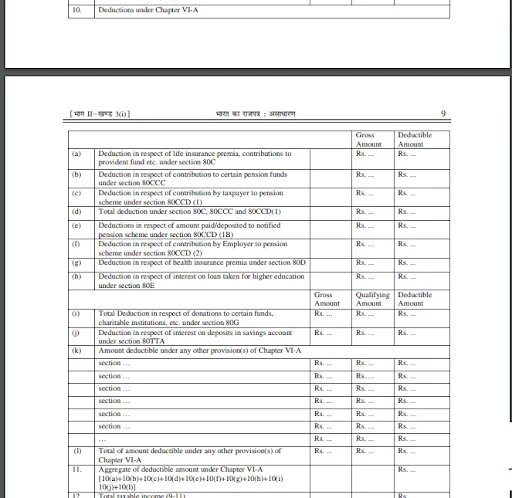
Part B of Form 16 is an Annexure to Part A. Part B is to be prepared by the employer for its employees and contains details of the breakup of salary and deductions approved under Chapter VI-A.

If you change your job in one financial year, you should take Form 16 from both employers. Some of the components of Part B notified newly are:

  • Detailed breakup of salary
  • Detailed breakup of exempted allowances under Section 10
  • Deductions allowed under the Income Tax Act (under chapter VIA):
    The list of deductions mentioned are as below:
    • Deduction for life insurance premium paid, contribution to PPF etc., under Section 80C
    • Deduction for contribution to pension funds under Section 80CCC
    • Deduction for employee’s contribution to a pension scheme under Section 80CCD(1)
    • Deduction for taxpayer’s self contribution to a notified pension scheme under Section 80CCD(1B)
    • Deduction for employer’s contribution to a pension scheme under Section 80CCD(2)
    • Deduction for health insurance premium paid under Section 80D
    • Deduction for interest paid on loan taken for higher education under Section 80E
    • Deduction for donations made under Section 80G
    • Deduction for interest income on savings account under Section 80TTA
  • Relief under Section 89

Details required from Form 16 while filing your return

With reference to the image below, here is where you can locate certain information for filing your income tax return for FY 2020-21 (AY 2021-22).

  • Allowances exempt under Section 10
  • Break up of deductions under Section 16
  • Taxable salary
  • Income (or admissible loss) from house property reported by an employee and offered for TDS
  • Income under the head ‘Other Sources’ offered for TDS
  • Break up of Section 80C deductions
  • The aggregate of Section 80C deductions (gross and deductible amount)
  • Tax payable or refund due

Form 16 – Part B

It shows your name (taxpayer’s), address and PAN. You can also find additional information of your employer in your Form 16 while filing your annual return, such as:

  • TDS deducted by the employer
  • TAN of employer
  • PAN of employer
  • Name and address of employer
  • Current assessment year
  • Your PAN

What is the eligibility criteria for Form 16?

According to the regulations issued by the Finance Ministry of the Indian Government, every salaried individual whose income falls under the taxable bracket is eligible for Form 16.

If an employee’s income does not fall within the tax brackets set, they will not need to have Tax Deducted at Source (TDS). Hence, in these cases, the company is not obligated to provide Form 16 to the employee.

However, these days, as a good work practice, many organisations issue this certificate to the employee as it contains a consolidated picture of the individual’s earnings and has other additional uses.

Points to be noted while checking Form 16

  • Once an individual receives Form 16 from the employer, it is their responsibility to ensure that all the details are correct.
  • One should verify the details mentioned in Form 16, for example, details of the amount of income, TDS deducted, etc.
  • If any of the detail is mentioned incorrectly, one should immediately reach out to the organisation’s HR/Payroll/Finance department and get the same corrected.
  • The employer would then correct their end by filing a revised TDS return to credit the TDS amount against the correct PAN. Once the revised TDS return is processed, the employer will issue an updated Form 16 to their employee.